
You spent years in university mastering the nuances of the human body. You can identify a Grade II ATFL tear from across the room, design a progressive rehab program for an elite triathlete in your sleep, and your dry-needling technique is a work of art. But here is the cold, hard, unvarnished truth of private practice in South Africa: Clinical excellence gets patients through your door, but data-driven logic keeps your door open.
For many physiotherapists—especially those transitioning from Community Service into the private sector—stepping into “Private” feels like being thrown into the deep end of the Atlantic during a Cape storm. Suddenly, you aren’t just a clinician; you are a business owner, a marketer, a debt collector, and an administrator. You have the skills to heal, but do you have the metrics to grow?
Monitoring your performance isn’t just about “doing admin” or looking at your bank balance at the end of the month. It is about reading the vital signs of your business. If a patient walked into your rooms with a resting heart rate of 140 bpm and a blood pressure of 180/120, you wouldn’t tell them to “rest up and check again next month.” You would act immediately. Why the hell, then, do so many practitioners treat their business’s critical warning signs with passive indifference?

The “Freshly Graduated” Blind Spot: Beyond the Plinth
Our universities are world-class at training clinicians, but they are notoriously quiet on the mechanics of entrepreneurship. Newly qualified practitioners and those entering private practice for the first time often excel at practical, hands-on skills but suffer from profound “clinical tunnel vision.” They focus entirely on the patient on the plinth while remaining blissfully unaware of the “leak” in their schedule, the “drag” in their billing cycle, or the steady decline in their referral patterns.
In a South African healthcare landscape characterised by stagnant medical aid rates, rising inflation, and a widening gap between what your clinical expertise is worth and what schemes are willing to pay, survival requires more than a warm bean bag and a friendly bedside manner. It requires an intimate, active understanding of business metrics.
Too many young practitioners suffer from what we call “physio guilt”—feeling inherently uncomfortable with charging private rates, pushing for complete treatment plans, or enforcing cancellation policies. They view medicine as a pure calling and business as a necessary evil. But if your practice is not financially sustainable, you cannot serve your community. If you don’t know your numbers inside out, you aren’t running a healthcare practice; you are running a very high-stress, low-yield, exhausting hobby.
The Radar vs. The Rearview Mirror: Leading vs. Lagging Metrics
To build a resilient practice, you must first master a fundamental distinction in business logic: the difference between Leading (predicting) and Lagging (reflecting) metrics. In my experience, too many physiotherapists operate their practices entirely without a structured, proactive plan. They run their businesses by “feeling” or “vibes,” only looking at a single metric: the bank balance at the end of the month. This is the ultimate lagging metric.

How are you driving your practice?
If you don’t distinguish between these two, you are essentially driving a car down the N1 at 120 km/h while staring exclusively through the rearview mirror. By the time you see the obstacle (a cash flow crunch), you’ve already crashed. Building a strategy around leading metrics in advance makes your practice infinitely stronger, highly adaptable, and significantly more likely to succeed.
The “New Patient” Attraction Ratio & Volume Trend (Leading Indicator)
The Metric: The percentage of your total monthly appointments that consist of first-time visits (New Patients vs. Existing Patients) paired with your New Patient Volume Trend (the absolute number of new bookings week-on-week and month-on-month).
The Logic: This metric is a powerful leading indicator of your future treatment volume, market relevance, and local reputation. If your New Patient Ratio is too low, your future pipeline is quietly starving. If it is too high, you have a “leaky bucket” syndrome—you are spending time and energy bringing people in, but failing to retain them through a complete cycle of care.
However, looking at the ratio alone is not enough; you must measure the absolute New Patient Volume Trend to evaluate the true effectiveness of your marketing and referral networks.

Preventing the New Patient Flatline
A sudden flatline in your new patient intake is one of the most frustrating and dangerous events in private practice. Because of the natural lag in healthcare marketing, once your new patient numbers hit zero, it typically takes at least two weeks of aggressive networking and outreach to regain momentum.
Catching it early prevents the Depth of the Anxiety
If you monitor this trend in real time and detect an early below-average dip, you can take immediate action to prevent the slump from rolling over and contaminating your revenue for the next month.
The Practitioner Recall Blind Spot & The Panic cost cutting Trap
In my experience, if you ask the average physiotherapy practice owner to tell you exactly how many new patients they took in over each of the last four months, they will look at you blankly. They simply cannot recall the data. Because they don’t track the volume trend in real time, they remain completely unaware of the flatline until the lagging metrics catch up.
When the bank account eventually runs dry, they react with panic. Instead of stepping out of the clinic to proactively market, build relationships, and network with local GPs, gyms, or corporate offices, they go on a desperate, inward-looking cost-cutting spree. They slash marketing, cancel educational sponsorships, and compromise on clinical consumables to salvage their immediate financial obligations. This is a fatal strategic mistake: you cannot cost-cut your way out of a clinical volume crisis. Being proactive with your inbound pipeline is the only way to survive.
The Standard Practice
Physio A runs a decent local rooms. They see 5 new patients a week, which feels comfortable. However, 80% of these referrals come from a single GP in their medical centre. They have a fantastic relationship with Dr Pieterse.Meeting the Standard
But what happens when Dr Pieterse retires, relocates to Canada, or starts referring to the flashy new rehabilitation clinic down the road? Over the course of a single month, Physio A’s referral channel completely evaporates. Because they don’t track their monthly trends, they only notice the crisis weeks later and react by cutting their software subscriptions and reception hours, accelerating their downward spiral.
The Thriving Practice
Physio B targets a consistent New Patient Ratio of 15% to 20% and monitors their absolute volume trend weekly. They don't guess where their patients come from; they track it systematically.Mastering the Metric
They tag every new patient in their database: Is it Google Maps? The local school? The nearby running club? A word-of-mouth referral from an existing patient? When they notice new patient intake has dipped 25% below their historical monthly average by the second week of the month, they act instantly. They book a face-to-face catch-up with local sports medicine specialists and launch a targeted local digital campaign, successfully averting a cash-flow rollover.
The Strategic Implication: Relying on a single source of patients is the business equivalent of hanging by a single climbing rope over a gorge. Diversifying your inbound pathways and acting on volume trends immediately is your safety net.
New Patient Ratio = (Number of New Patients) / (Total unique patient consultations) X100
If this calculation yields a result below 10%, your brand is becoming invisible in your community. If it yields over 35%, you are working incredibly hard to acquire patients who are leaving after one visit.
Average Visits per Patient (AVP)
The Metric: Total appointments completed divided by the total number of unique patients treated within a specific period.
The Logic: This is a delicate, highly scrutinized balance of clinical efficacy, ethical care, and business viability. It functions as both a clinical benchmark and a leading indicator of patient retention and medical aid compliance.
- Too Low (< 3.0): You are likely “patching” symptoms rather than curing the underlying pathology. A patient comes in with acute lower back pain, you dry-needle them, they feel better the next day, and they cancel their follow-up. You let them go. Within three weeks, the pain returns because their core stability wasn’t addressed. They don’t blame their lifestyle; they blame you, concluding that “physiotherapy doesn’t work” and going to a biokineticist or chiropractor instead.
- Too High (> 10.0 for simple cases): You risk triggering “over-servicing” flags on the automated monitoring algorithms of major medical schemes like Discovery, GEMS, or Medscheme. Once flagged, you face the nightmare of retrospective forensic audits, clawbacks, and suspension of your direct-payment agreements.
Think of AVP metric as a vehicle’s GPS. If you are taking 15 complex turns to reach a destination that usually takes 4, your treatment route is highly inefficient. Conversely, if you kick the passenger out of the car halfway to their destination, you haven’t completed the journey.

The AVP “Sweet Spot” Clinical Spectrum
A thriving practice understands that a healthy “sweet spot” (typically between 4.2 and 5.5 visits for general musculoskeletal conditions) proves that you are delivering a comprehensive, evidence-based rehab cycle. It shows you aren’t just treating the pain; you are treating the human, rebuilding their movement patterns, and preventing recurrence.
It is critical to note that these quantitative benchmarks are strictly applicable to Outpatient practices. Hospital-based practices—which focus on acute ward-based rehabilitation, high-care/ICU mobilisations, or immediate post-operative protocols—operate on an entirely different frequency interval. In-hospital physiotherapy is driven by acute length-of-stay parameters, daily (or even twice-daily) short-duration chest or mobility sessions, and immediate discharge planning. Comparing a hospital-based AVP to an outpatient AVP is fundamentally flawed, as each serves an entirely distinct clinical purpose and recovery velocity.
To put this outpatient metric in perspective, let’s contrast how different practices manage their clinical plans:
The Standard Practice
Physio A runs a suburban outpatient practice but operates on a low AVP of 1.8. They focus primarily on immediate symptom relief. A patient with shoulder impingement receives manual therapy and dry needling, feels immediate relief, and is sent on their way with a 'let me know if it flares up' sign-off.Low AVP
Because the underlying kinetic chain issues, rotator cuff weakness, and scapular dyskinesis were never addressed, the patient relapses within a fortnight. Feeling let down, they book an appointment with a competitor. Physio A’s low AVP has resulted in poor patient durability, low customer lifetime value, and an exhausting treadmill of chasing constant new patient acquisitions to keep the lights on.
The Thriving Practice
Physio B maintains an outpatient AVP of 4.8. During the initial consultation, they explicitly manage the patient's recovery expectations. They explain that reducing acute inflammation is only Step 1, while Steps 2 and 3 focus on motor retraining and progressive tissue loading to prevent reinjury.Optimal Outpatient AVP
The patient commits to a structured, 5-session care plan. As a result, the patient fully recovers, refers their colleagues, and Physio B’s practice benefits from highly stable, predictable clinical volumes and healthy, ethical practice growth.
It is incredibly easy to fall into the defensive trap of believing that you have absolutely no control over whether a patient follows up or commits to their treatment plan. It is highly convenient to blame external variables, telling yourself that a patient simply lacked motivation or was too busy. However, when we perform true clinical introspection and reflect deeply on how we could have handled that initial contact session differently to achieve a better outcome, we realise that the power was largely in our hands.
A more detailed and empathetic subjective assessment, a sharp and targeted objective assessment, a more appropriate selection of treatment modalities, or a better clinical technique could have changed the trajectory. Crucially, how we debriefed our findings, set expectations, and mapped out clear recovery milestones is what ultimately dictates patient buy-in. I will discuss this clinical communication framework in a future article to completely unpack how you can influence this metric from your very first interaction on the plinth.

“Slow Money” vs “Fast Money” (Collection Rates – Lagging Indicator)
The Metric: The actual Rand value of cash collected in your bank account versus the total Rand value billed to patients and medical aids.
The Logic: In South Africa, not all Rands are created equal. You cannot pay your rent, your staff, or your suppliers with “pending claims.” You need to understand the velocity of your money through this vital lagging indicator:
- “Fast Money”: Cash, card payments at the time of consultation, and immediate electronic funds transfers (EFTs).
- “Medium Money”: Direct-paying medical aids with clean claim cycles (usually 14 to 30 days).
- “Slow Money”: COID (Workmen’s Compensation) and RAF (Road Accident Fund) claims. These require mountains of complex, specialised paperwork such as W.Cl.4 progress reports, employer certificates, and police reports. If processed incorrectly, these claims can take months, or even years, to pay out.
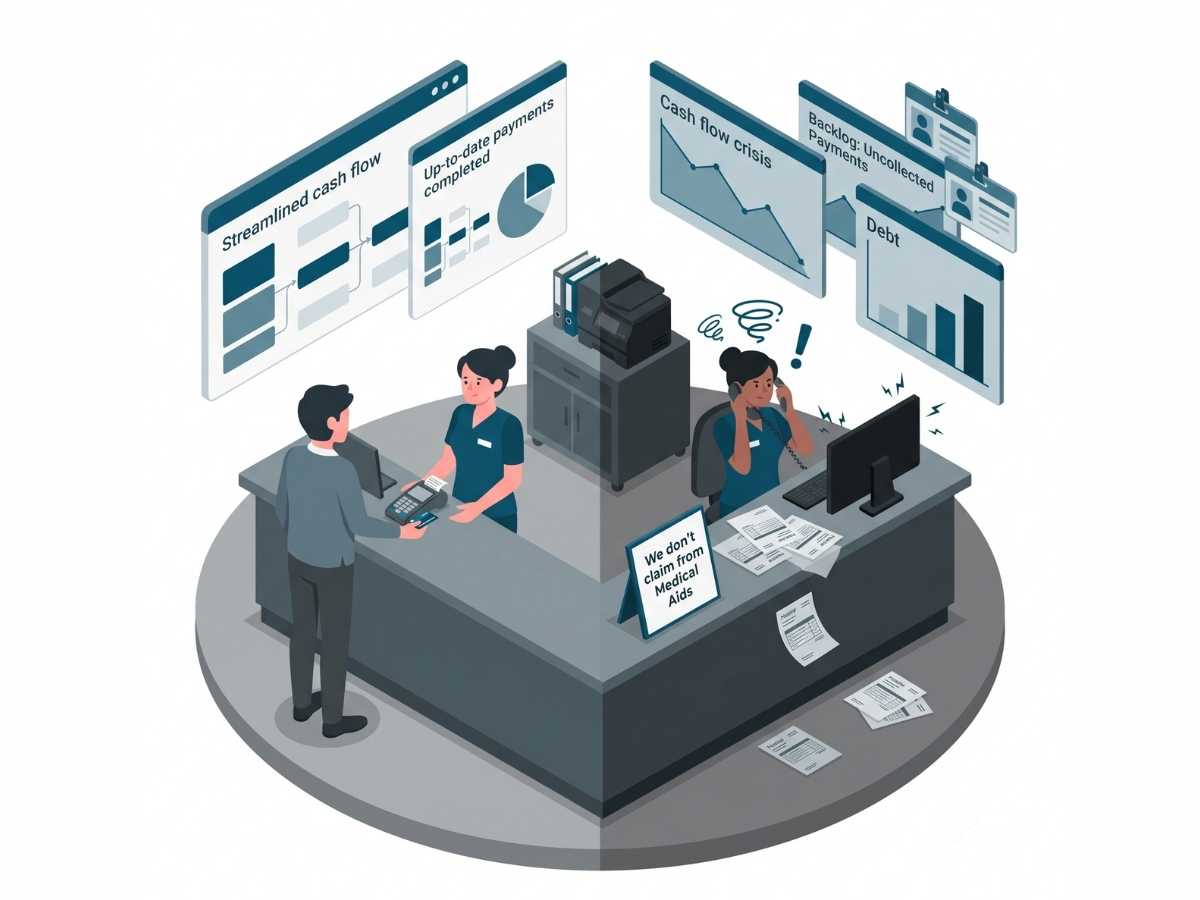
The Standard Practice
Physio A treats 10 patients a day and boasts a 'fully booked' diary. However, they ignore their Ageing Debtors Report.Meeting the Standard
They happily take on every COID and RAF claim that walks through the door without verifying the employer’s registration or tracking the submissions. At the end of the quarter, their bank account is bone dry. They cannot pay their lease because 35% of their billed revenue is locked in “Slow Money” limbo or has been rejected due to outdated ICD-10 codes and “savings exhausted” clauses.
The Thriving Practice
Physio B maintains a strict 98% Collection Rate as a non-negotiable business benchmark. They utilise live billing systems that instantly run real-time eligibility checks before a patient sits down.Mastering the Metric
The patient commits to a structured, 5-session care plan. As a result, the patient fully recovers, refers their colleagues, and Physio B’s practice benefits from highly stable, predictable clinical volumes and healthy, ethical practice growth.
Why the hell would you not monitor this? Running a practice with a 75% collection rate is equivalent to working for free every Thursday and Friday. You are paying for the electricity, the ultrasound gel, your training, and your time, but donating a quarter of your life to administrative black holes.
Too many practitioners adopt a “victim of the system” mentality that renders them feeling completely powerless against late medical aid payouts and complex claims rules. However, this is fundamentally a systems and structural problem; your administration must be set up correctly to ensure that patient accounts, follow-ups, and medical aid claims are handled with the exact same dedication, precision, and clinical professionalism as your actual medical services.
The 24-Hour No-Show Leak (Leading Revenue Indicator)
The Metric: The percentage of your available booking slots that are lost due to late cancellations (less than 24 hours’ notice) or complete “no-shows” or DNA (Did not attend).
The Logic: Time is your only finite inventory. A retailer can store unsold shoes in a backroom and sell them tomorrow. You cannot stockpile your 09:00 AM slot. Once the clock strikes 10:00 AM, that unutilized hour is gone forever, never to be monetized again.
Let’s look at the brutal, unvarnished math of a seemingly minor “No-Show Leak.” Imagine you charge a standard rate of R750 per session:
Metric
- No-Shows / Late Cancellations
- Annual Financial Loss
Impact on 1 Practitioner
- Just 1 per day
- R 180,000
Impact on 3 Physio Practice
- 3 per day
- R 540,000
The Reality Check: By failing to manage this single leak, a solo practitioner is flushing the equivalent of a luxury holiday or a massive practice upgrade down the drain every single year. A multi-physio practice is losing more than half a million rand—the salary of an entire additional therapist or a downpayment on prime medical real estate.
Thriving practices don’t tolerate this leak. They plug it using a four-step system approach:
The Phone Call Metric & AI Revolution (Leading Indicator)
The Metric: Call Answer Rate (percentage of incoming calls answered within three rings) and Call-to-Booking Conversion Rate.
The Logic: Your phone is the front door of your business. If a prospective patient dials your number and the call goes unanswered, they don’t leave a voicemail. They hang up, return to their Google Search, and click on the next competitor on the list.

An unanswered phone is an active referral to your nearest competitor.
The dawning age of Artificial Intelligence is rewriting the rules of practice administration. To remain competitive in the modern marketplace, you must adapt or stay in the dark ages. In the near future, patients won’t just expect an answer during business hours—they will expect to be able to call, book, or reschedule appointments 24 hours a day, 365 days a year.
The Hybrid Virtual Assistant Model
The dawning age of Artificial Intelligence is rewriting the rules of practice administration. To remain competitive in the modern marketplace, you must adapt or stay in the dark ages. In the near future, patients won’t just expect an answer during business hours—they will expect to be able to call, book, or reschedule appointments 24 hours a day, 365 days a year.
From Answering Machine to Practice Catalyst
When a digital receptionist sits in the primary front desk chair, the impact on your operational efficiency, administrative workflow, and practice growth is monumental.
Traditionally, practice administrators spend up to 60% of their workday glued to the telephone, constantly interrupted by cold callers, directions inquiries, or routine bookings. This keeps them in a reactive state, unable to complete high-value work.
By offloading the telephone burden to an AI partner, your administrative personnel are liberated to pivot their role from a passive booking operator to an active practice manager:
- Proactive Patient Retention: Instead of answering phones, they can run structured follow-up campaigns—calling patients who completed therapy two months ago to check on their long-term recovery, or messaging patients who missed an exercise progression.
- Inventory and Stock Management: They can actively manage practice retail stock (foam rollers, Therabands, strapping tape, and orthotics), turning inventory management into an active revenue-generating centre.
- Client Experience Optimisation: They can focus on the patient physically sitting in your waiting room—offering a brilliant cup of coffee, explaining complex medical aid authorisations face-to-face, and ensuring the clinic feels warm, welcoming, and premium.
“When Life Happens” Fail-Safe
Consider a common, highly stressful South African scenario. It’s a rainy Monday morning. Your receptionist, Lerato, wakes up with a severe migraine, her car won’t start, or a sudden localised taxi strike halts public transport.
In the Traditional Model
Your phone rings off the hook. Prospective patients with acute pain get your voicemail, hang up, and book elsewhere.Vulnerable & Unpredictable
You have to step away from your patients on the plinth to answer phone calls, destroying your clinical rhythm, losing focus, and running 45 minutes late for the rest of the day. The practice descends into administrative chaos.
In the Hybrid AI Model
Lerato stays home to recover without guilt. The AI digital receptionist takes the front desk chair.Automated fail-safe
Every call is answered on the first ring, patients are booked, and simple questions are answered. When Lerato returns, she logs in to find a cleanly organised diary, zero missed calls, and a list of structured, high-value tasks waiting for her.
Why the hell would you leave your clinic’s primary entry point vulnerable to human unpredictability when an automated, conversational fail-safe can protect your practice round-the-clock?
The Patient Loyalty Score & The Experience Loop (Leading Indicator)
The Metric: Patient Loyalty Score (PLS), captured via automated patient experience surveys sent within 24 hours of clinical discharge or a major rehabilitation milestone.
The Logic: Clinical skills operate in a vacuum if the patient journey to access them is deeply flawed. This metric measures the satisfaction patients experience with your entire practice ecosystem. It evaluates reception bookings, phone response times, ease of communication, facility cleanliness, and the ultimate golden standard: their willingness to recommend your practice to family and friends. It converts your patients’ trust into loyalty, encouraging them to become active word-of-mouth advocates.
The Surgeon’s Gatekeeper
To understand why the PLS is so critical, consider this scenario:
There is an internationally respected, world-class orthopaedic surgeon operating in Johannesburg. His clinical reasoning is flawless, and his surgical outcomes are legendary. However, his private rooms look like a dingy, dimly lit municipal office from 1982. Worse yet, his receptionist is a fierce “gatekeeper” who treats every caller like an unwanted interloper. She has zero empathy for patients in a pain crisis, ignores emails for days, and refuses to pick up the ringing telephone because she proudly declares that they “only accept booking queries between 9:00 and 11:00 on alternating Mondays.”
When a patient interacts with this practice, they arrive at a clear, painful conclusion: “The professional was amazing, but the experience was absolute hell.”
The patient might walk out with a perfectly repaired joint, but they will never return, or endure with perseverance. They will certainly never refer their family, friends, or running club. It only takes a few patients echoing this exact same tune on Google Reviews, social media, or local community groups for the referral pipe to freeze. The surgeon sits in his empty, pristine theater, wondering where his business went, entirely blind to the fact that his front desk built a wall to keep patients out.
Protecting Your Reputation with a Pressure Valve
The statistical benchmark for a healthy Patient Loyalty Score is 70%. This score represents the holistic quality of your patient’s non-clinical experience, not your degree of clinical reasoning. If you find your overall score slipping below 70%, you have serious internal work to do.
Crucially, implementing an automated feedback loop serves as a vital reputation pressure valve. It provides a structured, private platform for unhappy, frustrated patients to safely vent their grievances directly to you. This gives you the golden opportunity to step in, apologise, make operational adjustments, and actively repair the relationship before they resort to damaging your brand, your Google rating, and your professional reputation through toxic public reviews or negative word of mouth.
Even if you pride yourself on immaculate clinical standards and firmly believe that your practice has “never done it”—that you or your team have never dropped the ball on a patient’s experience—ask yourself what you will do when a scathing, highly emotional patient rant is floating around the web for your entire referral network of local doctors and prospective patients to see. When that public fire starts, years of building professional credibility can evaporate overnight.
Ultimately, it is completely unrealistic to expect yourself or your employed therapists to deliver 100% flawless clinical and interpersonal performance every single hour of every gruelling workday. Burnout occurs, personal struggles leak in, and human communication naturally misfires. The goal is not to police perfection, but to build proactive, structured systems that provide a direct, private feedback chain that you can monitor. This flow of data allows you to easily observe if one of your practitioners is slipping up. Very often, a practice owner’s quiet, intuitive suspicion about a disengaged therapist or a struggling front-desk workflow is completely true. This metric gives you the objective, constructive evidence you need to step in, support your team, and get them back on track before any lasting damage is done to your brand.

The Downward Spiral: Termites in the Foundation
Unattended clinical and business problems in a practice are like termites. By the time you notice the physical damage—a rejected credit application, a bounced debit order, or a late SARS payment warning—the wooden structural beams of your business are already hollowed out.
Consider how quickly a minor, unmonitored metric can trigger a catastrophic downward spiral
This is the fundamentally hidden nature of business metrics. They don’t make a loud noise when they start to fail. They drift quietly, in fractions of a percent, until the cumulative pressure snaps the business in half.
This is exactly where an intelligent, live billing system changes the entire game. We do not look back at your practice retrospectively at tax season and offer an autopsy on why you lost money. Instead, our systems act as a live physiological monitor. If your collection rate drops by even 1.5%, we see it immediately. If your AVP begins to slide toward the danger zone, the dashboard alerts us. We give you the clean, hard data you need to make a strategic business adjustment before the problem snowballs.

The Thriving Practice Checklist
The statistical benchmark for a healthy Patient Loyalty Score is 70%. This score represents the holistic quality of your patient’s non-clinical experience, not your degree of clinical reasoning. If you find your overall score slipping below 70%, you have serious internal work to do.
Crucially, implementing an automated feedback loop serves as a vital reputation pressure valve. It provides a structured, private platform for unhappy, frustrated patients to safely vent their grievances directly to you. This gives you the golden opportunity to step in, apologise, make operational adjustments, and actively repair the relationship before they resort to damaging your brand, your Google rating, and your professional reputation through toxic public reviews or negative word of mouth.
Even if you pride yourself on immaculate clinical standards and firmly believe that your practice has “never done it”—that you or your team have never dropped the ball on a patient’s experience—ask yourself what you will do when a scathing, highly emotional patient rant is floating around the web for your entire referral network of local doctors and prospective patients to see. When that public fire starts, years of building professional credibility can evaporate overnight.
Ultimately, it is completely unrealistic to expect yourself or your employed therapists to deliver 100% flawless clinical and interpersonal performance every single hour of every gruelling workday. Burnout occurs, personal struggles leak in, and human communication naturally misfires. The goal is not to police perfection, but to build proactive, structured systems that provide a direct, private feedback chain that you can monitor. This flow of data allows you to easily observe if one of your practitioners is slipping up. Very often, a practice owner’s quiet, intuitive suspicion about a disengaged therapist or a struggling front-desk workflow is completely true. This metric gives you the objective, constructive evidence you need to step in, support your team, and get them back on track before any lasting damage is done to your brand.
Reclaiming your administrative health is easy to map out on paper, but incredibly difficult to execute in a busy clinical routine. Our specialised billing bureau is built to do this heavy lifting for you. We know that the vast majority of South African physiotherapy practices do not take the time, nor do they possess the tracking systems, even to measure and compile the raw data points required to run these essential business diagnostics. If you are one of them—running your business on intuition, stress, and hope—we strongly advise you to contact us today. Let our system serve as your practice’s operational foundation, automating your metrics and cleaning up your revenue cycles so you can build a resilient, storm-resistant enterprise before the next crisis arrives.
We Handle the Tracking complexity, You Handle the Patients
We understand that looking at a spreadsheet or interpreting dry financial charts makes most physiotherapists want to lock themselves in a treatment room. You became a physiotherapist because you love human interaction, biomechanics, clinical problem-solving, and the deep satisfaction of helping people reclaim their physical freedom. You did not become a physio to spend your evenings arguing with medical aids over modifier codes or hunting down unpaid R350 co-payments.
Don’t let your business run on “vibes,” guesswork, and hope. Run it on clean, precise data. Because at the end of the day, if you aren’t measuring it, you aren’t managing it. And if you aren’t managing your business, why the hell are you taking on all the stress of running it?
Our professional billing service is designed to be your business’s “Second Brain.” We take all of the complex, messy, and stressful data and translate it into a simple, automated, and actionable reality. We monitor your metrics live, submit your claims cleanly, handle your collections professionally, and flag potential issues before they can threaten your livelihood.
We manage the business metrics so you can focus entirely on clinical excellence.
Stop the guesswork and reclaim your clinical peace of mind. Contact us today to see how our live billing data can turn your private practice into a thriving, resilient business.